


Hall County Commissioners have public hearing about continuation of Hall County Rural Transportation
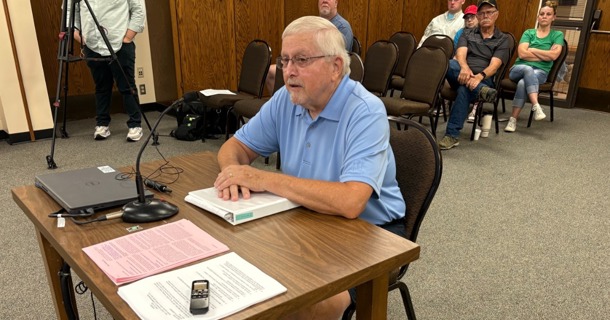
GRAND ISLAND – Hall County Commissioners had a public hearing June 30 concerning continuation of services from Hall County Rural Transportation.
From the people who spoke during the hearing, mention was made of people needing the transportation to get to their jobs and people needing the transportation to get to medical appointments.
The topic was on the agenda as a public hearing only, so Commissioners took no action regarding the program.
After the hearing ended, Commissioner Scott Sorensen made a motion to have him, Hall County Attorney Marty Klein, and Brown Transit (the current provider) to go over the contract in the next two weeks to see what options are available. Commissioners voted 7-0 to approve the motion.
Commissioners last discussed the issue at their May 31 meeting. Bob McFarland, transit manager, said that the transportation service was in danger of closing because of reductions in state and federal money. The county’s transportation system is separate from one operated by the city of Grand Island.
McFarland said that the county’s transportation system became separate from the city system approximately three years ago. While the county’s cost per rider is $147, a resident pays $2 for a one-way ticket.
Mindy Littlejohn said she has lived in Hall County for 35 years, She said that without the transportation, her son (Gavin Trotta) would not be able to go to work for the Bosselman company. He works from 8 a.m. to 1 p.m. She said it is affordable, and he is contributing to society. If transportation is discontinued, it would take vulnerable people out of the workforce. When considering other possible transportation such as Uber, Littlejohn said the situation is not as good as the Hall County system because riders can talk to a driver with whom they are familiar. Littlejohn suggested that the $2 fee could be increased, but later Commissioner Ron Peterson said that a fare increase would negatively affect how much money the county received. He said there would be no advantage to raising the rates.
Gavin Trotta, who is autistic, works for the Bosselman Pump and Pantry northwest of the intersection of Highway 281 and Capital Avenue. He said that he performs janitorial duties there, I feel completely safe going from home to work. He said that he has good communication with the bus drivers that work for the Hall County system. His shifts are from 8 a.m. to 1 p.m., Monday through Friday.
Pam Franks said that she is Trotta’s grandmother, and Trotta lives with her. They live outside of the city of Grand Island. Gavin has been working for Pump and Pantry for three years. His mother mentioned that he was born autistic.
“Grand Island has been an amazing community to live in for special needs children,” Franks said. She said that Grand Island Public Schools does a great job. She said she works a full-time job, and his mother works full-time.
“Gavin is in a position where he never will be able to drive,” Franks said.
Giving public transportation, he can be a taxpayer.
“We want him to continue to be a valuable part of our society,” Franks said.
She said that a number of people don’t know about the public transportation available in Grand Island and Hall County. She said that the transportation system should be publicized more.
She said that she learned about the city transportation system when she was driving and was behind a city transportation vehicle. She said that the cost of Uber would be prohibitive.
The city and the county need the transporation services.
Her elderly parents have used city transportation to take them to medical appointments.
Shannon McWhirter said a few months ago, she developed a compressed nerve in her spine, and that has made it so can’t feel a leg. In order to correct that, she’s been going to physical therapy three times a week. Her husband works overnight and sometimes days, so he may not be available to provide transportation for her. She said that she and her family live near Doniphan. In order for her to go to physical therapy, she has to use the Hall County transportation system. She said that children are home-schooled and use the Hall County transportation system. She said that people who do not have special needs also need the transportation system. She said that her family probably uses the Hall County transportation system daily.
Keith Baumfaulk said that he was speaking in a dual role. He is one of the drivers for Hall County transportation and is also a Hall County resident. By being a driver, he said he has made connections with a lot of people. He knows of several riders with special needs who need the transportation to get to their jobs. He is concerned that their situations may regress if public transportation is no longer available. People are in wheelchairs use the transportation and some do not have families here. Baumfaulk said that people who live in facilities such as nursing homes have to pay a higher price to use the facilitiy’s transportation than if they use the county’s transportation. There is a need for this transportation, he said.
Carol McWhirter said she has been a Hall County resident for 47 years, She and her husband are retired farmers and live in rural Doniphan. She said that the transportation system is life-changing. She wondered whether Commissioners could find funding for the transportation system elsewhere in the county’s budget.
“I appreciate this wonderful service that is so unique to Hall County,” she said.
McFarland compared this service to other services that the county offers. He said that the Hall County system is a not a “life or death” situation but is a “life or worse life” situation. He said that if people lost their jobs, it would affect them.
To keep the transportation service going Is less than half of what the county spends on ambulance services, McFarland said.
The additional expense to the county to keep the transportation system is $110,000 to $115,000 annually.
Commissioner Scott Sorensen said that he had asked Casey Muzic, director of the Midland Area Agency on Aging and the Midland Public Transit, and Pam Artertburn, who is Midland Public Transit manager, to attend the meeting. Muzic said that the transit serves people who live in Clay, Howard, Merrick, Nuckolls and Webster Counties.
Sorensen said that there seems to be a big difference in cost per ride for Midland Public Transit than for Hall County transportation. The average price for Midland Public Transit is $50 to $60, Muzic said. They have economies of scale operating in five counties, Sorensen said.
Muzic said that in addition to serving the five counties, Midland Public Transit also serves people in Hall and Adams counties who are on Medicaid. Midland has vehicles in each county. Muzic said that there are a lot of requirements for someone to provide transportation for people on Medicaid. Medicaid also requires extra training of drivers.
Sorensen said that Commissioners need to decide which direction that they want to go, and the decision will not be easy. Sorensen said that he would like to see the county get new bids for providing transportation to see if there any options at a lower rate. He said that Brown Transportation, the current provider, has done a good job.
Sorensen said he does not want to see a lapse in service.
Lancaster described the transportation system development as “heartbreaking.”
Lancaster wondered whether an endowment could be set up to support Hall County transportation. She said it was a thought that would help continue the service. She said that in the past, donations were accepted for Hall County Park.
Sorensen said that had been previously mentioned getting donations to help pay for transportation, but that the Nebraska Department of Transportation would then reduce funding for Hall County.
Quandt said that it is a badly needed service and is a life-changer for residents. Quandt said it needed to be determined how the transportation cost could be feasible.
Peterson said that the Board will investigate further options.
Sorensen said that it would be good to have a decision made before the county finalizes its budget for the next fiscal year. The current contract requires a 90 day notice for service changes.
After the hearing, McFarland said that the cost to the county would be between $105,000 and $150,000 annually. He said that people need the transportation to go to things such as jobs or medical appointments. He said that the service is “life changing.”
McFarland said that the county began operating its own transportation two years ago. Prior to that, it was a combined service with the city. He said the local transportation program began in the 1970s and was operated as a senior handibus. Originally it was a senior handibus system, and now it is for all residents.
He said that the Hall County program has five vehicles, four of which are operational. All of their vehicles have close to 200,000 miles on them.
Commissioner Scott Sorensen said after the meeting that one option is maintaining service with Brown Transit. A local match of $110,000 would be needed. Another option is renegotiating the contract or rebidding the contract.
Sorensen said his personal opinion is that as the population continues to age, the need for transportation is something that will go away anytime soon.